When you buy through links on our articles, Future and its syndication partners may earn a commission.

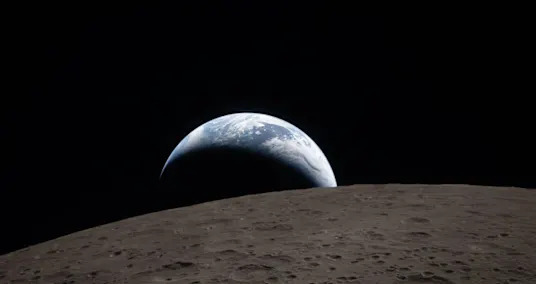
The Artemis 2 crewmembers captured a spectacular view of Earth setting behind the moon through the window of their Orion spacecraft on Flight Day 6 of NASA's historic 10-day mission, as they passed over the far side of the lunar surface. They called it "Earthset," in reference to the iconic image captured by Bill Anders on Christmas Eve in 1968 during the Apollo 8 mission.
What is it?
The photo was captured at 6:41 p.m. EDT (1041 GMT) on April 6, as the majority of Earth's surface was veiled in shadow from the perspective of the Artemis 2 crew. Just a crescent of our planet could be seen illuminated by direct sunlight, revealing white clouds swirling over Australia and Oceana.
Countless craters can be seen scarring the moon's ancient surface, including the 40-mile-wide (64-kilometer-wide) expanse of Ohm Crater, which can be seen close to where the lunar horizon meets the shadowed night side of Earth. The crater features a prominent central peak and a sloping "terraced" rim.

NASA's Reid Wiseman, Victor Glover and Christina Koch and the Canadian Space Agency's Jeremy Hansen — the crew of the Orion spacecraft they named "Integrity" — witnessed Earth slip silently from view shortly after, as they passed over the far side of the moon.
They would later experience a planned 40-minute communications blackout while traveling beyond the range of NASA's relay satellites. But then, they witnessed an iconic "Earthrise" even more similar to what Anders saw in the 60s, as our Blue Marble emerged from behind its natural satellite.

The most detailed Artemis SLS Lego set, this adult-aimed model has 3,601 pieces and stands 28-inches (71 cm) tall. We thought "Lego has knocked it out of the park" in our full build review. Don't forget about the newer, more compact and much cheaper Lego Technic SLS set, only $60, also 'launches' with some clever Technic moving parts.
Later that day, the crew would be treated to one of the rarest sights in human history, a total solar eclipse witnessed from a free-flying spacecraft, as Orion's trajectory placed the moon between the NASA spacecraft and our parent star.
Want to know more? Then be sure to stay up to date with the latest news with our Artemis 2 liveblog. You can also find out what the Orion crew will be getting up to over the rest of their 10 day lunar trip with our day-by-day breakdown of the trailblazing mission, which has seen humans travel farther from Earth than ever before.
NEUESTE BEITRÄGE
- 1
 6 Vehicle Rental Administrations: Pick Your Ideal Ride06.06.2024
 - 2New science points to 4 distinct types of autism26.12.2025
- 3Best Pizza Beating: What's Your #1?01.01.1
- 4Best Food Truck Cooking: Decision in favor of Your Number one!01.01.1
- 5Israel strikes Iranian nuclear development facilities, Tehran vows retaliation27.03.2026



Ähnliche Artikel
- NASA will bring space station crew home early after medical issue08.01.2026
- Car Investigation: A Survey of \Past the Outside\ Car10.08.2023
- Novo Nordisk cuts Wegovy price in South Africa for a second time25.03.2026
- US FDA approves Kura-Kyowa's blood cancer therapy13.11.2025
- ByHeart infant formula recall tied to botulism outbreak puts parents on edge16.11.2025
- Astonishing Deserts All over The Planet You Really want To Visit06.06.2024
- When faith comes under fire: How Iran’s repression of religious minorities has increased25.12.2025
- IDF struck Iran's largest petrochemical plant, second facility hit in two days, Katz confirms06.04.2026
- $1,000 bribes, Mormon momfluencer mixers and making content to get plastic surgery: The wildest things I learned reporting my book02.04.2026
- Countdown begins for long-awaited Artemis II moon mission30.03.2026