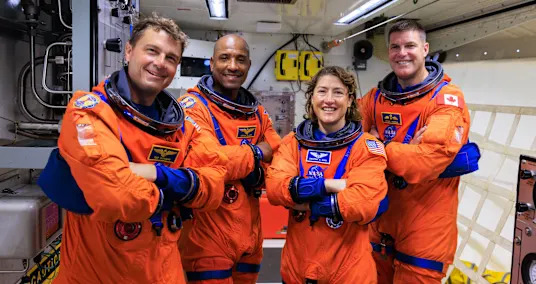
For the first time in half a century, countdown clocks began ticking Monday toward launch of a three-man one-woman crew on a trip to the moon and back, a major step in NASA's accelerated drive to establish a lunar beachhead with landings in 2028, followed by construction of a moon base.
With forecasters continuing to predict an 80% chance of favorable weather, Artemis II commander Reid Wiseman, Victor Glover, Christina Koch and Canadian astronaut Jeremy Hansen hope to strap into their Orion capsule and blast off atop a giant Space Launch System rocket at 6:24 p.m. EDT Wednesday.

"We just wrapped up our L(aunch)-minus two (day) mission management team review and the team polled go to proceed towards the planned April 1 launch attempt," said Amit Kshatriya, the NASA associate administrator.
The review included "the usual readiness items — vehicle status, ground systems, flight hardware and the integrated launch operations timeline," Kshatriya said. "We also reviewed the most recent engineering assessments (and) the team concluded that everything continues to look good, and there are no issues preventing us from pressing ahead."
Assuming an on-time liftoff, the crew will pass behind the moon next Monday, sailing 4,100 miles above the lunar far side before heading back to Earth for a Pacific Ocean splashdown on the southern California coast on April 10.
Mission duration: nine days and one hour, covering nearly 700,000 miles.
Countdown clocks began ticking at 4:44 p.m. EDT Monday. Engineers planned to spend the initial hours of the carefully orchestrated procedure readying the SLS rocket and ground systems for propellant loading and powering up the crew's Orion capsule. The astronauts, meanwhile, planned to enjoy dinner with family members at the nearby Cape Canaveral Space Force Station.
On Tuesday, the launch team will continue power-up and checkout operations, testing communications circuits and loading "late stow" experiment packages.

Early Wednesday, cockpit switches will be configured for launch, star trackers and navigation gear will be powered on and Launch Director Charlie Blackwell-Thompson will poll her launch team to make sure they're "go" for propellant loading, scheduled to begin at 7:44 a.m.
The core stage of the SLS rocket will be filled with 537,000 gallons of supercold liquid hydrogen fuel and 196,000 gallons of liquid oxygen. The rocket's upper stage, the Interim Cryogenic Propulsion Stage, or ICPS, will be loaded with another 24,000 gallons of liquid hydrogen and oxygen.
The process will take about five-and-a-half hours to complete. While fuel loading is underway, Wiseman and his crewmates will be awakened and given a weather briefing before donning their pressure suits and heading for launch pad 39B to strap in aboard the Orion capsule shortly before 2:30 p.m.
With the countdown in a final 30-minute built-in hold at the T-minus 10-minute mark, Blackwell-Thompson will poll the launch team again before giving permission to resume the countdown.

When the hold ends at 6:14 p.m., the ground launch sequencer computer will take over the countdown, the launch pad's crew access arm will be retracted and auxiliary power units will spin up to provide hydraulic power. The four main engines at the base of the SLS core stage will begin igniting six seconds before liftoff.
After a lightning round of computer checks to verify the engines are running normally, commands will be sent to fire the rocket's two strap-on solid-fuel boosters. As the boosters roar to life, explosive bolts at the base of each booster will shatter, and the SLS rocket will begin climbing away atop 8.8 million pounds of thrust.
At that point, flight controllers at the Johnson Space Center in Houston will take over from the launch team, monitoring ascent telemetry, providing guidance to the astronauts and managing a complex flight plan. NASA's first crewed moonshot in more than half a century will finally be underway.
"It is an exciting time," said Blackwell-Thompson. "It's an exciting time for this team and our crew and really our nation and the world. ... We'll fly when this hardware is ready, and we'll see if it's ready to go in just a couple of days. But certainly, all indications are right now we are in excellent, excellent shape."
Meet the masked artist who conjured a concrete jungle of 20,000 orchids
Ret. Gen. Frank McKenzie says "we're on our way" to making Strait of Hormuz passable
Olivia Munn sounds the alarm after shocking breast cancer diagnosis: "No symptoms"
NEUESTE BEITRÄGE
- 1
 Steinmeier honours Italian 'guest workers' who rebuilt German economy15.11.2025
 - 2Taylor Frankie Paul's domestic violence case is fueling discussions about DARVO. Experts say terms like this shouldn't be used lightly.26.03.2026
- 3NASA satellite gazes into Medusa Pool | Space photo of the day for Dec. 24, 202524.12.2025
- 4Horror and fear in West Bank as Israel approves hanging Palestinians convicted of murdering Israelis31.03.2026
- 5Kissing is an ‘evolutionary conundrum.’ Scientists just mapped its unexpected origins19.11.2025





Ähnliche Artikel
- France's Senate backs ban on social media platforms for under-15s31.03.2026
- Investigation reveals sperm donor passed on cancer risk to dozens of children across Europe10.12.2025
- Inconceivable Spots To Stargaze All over The Planet06.06.2024
- Investigate Something else for Less: Financial plan Travel Objections06.06.2024
- 6 Trail blazing Bicycles for Rough terrain Undertakings05.06.2024
- Why are NASA's Artemis astronauts wearing orange? What are they bringing to space? What to know about the preparation for their moon mission.30.03.2026
- US FDA investigates Takeda's blood disorder drug after pediatric death21.11.2025
- Overlooked infertility care should be part of national health services, says WHO28.11.2025
- Check out the exclusive pitch deck Valerie Health used to raise $30 million from Redpoint Ventures to automate healthcare faxes16.12.2025
- From invasive species tracking to water security – what’s lost with federal funding cuts at US Climate Adaptation Science Centers24.11.2025