When you buy through links on our articles, Future and its syndication partners may earn a commission.

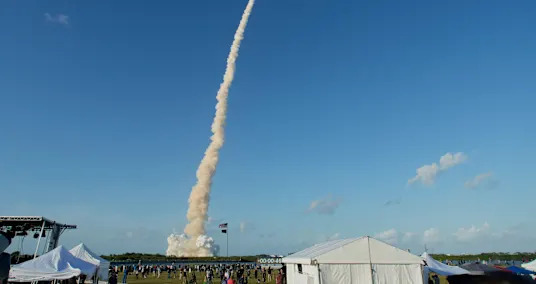
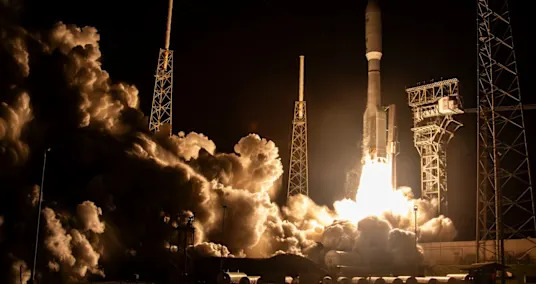
A United Launch Alliance (ULA) Atlas V rocket will launch its heaviest-ever payload on Saturday morning (April 4), and you can watch the action live.
The Atlas V is scheduled to lift off Saturday at 1:45 a.m. EDT (0545 GMT) from Florida's Cape Canaveral Space Force Station, carrying 29 satellites for the Amazon Leo broadband constellation to orbit. Together, those spacecraft weigh 18 tons, according to ULA.
You can watch it live here at Space.com, courtesy of ULA, or directly via the company. Coverage will begin 20 minutes before launch.

The Amazon Leo megaconstellation, previously known as Project Kuiper, will eventually consist of about 3,200 satellites in low Earth orbit. It's Amazon's answer to SpaceX's Starlink network, which beams internet service down from more than 10,000 satellites (and counting).
Amazon Leo is still in its early stages; just 212 of the spacecraft have reached orbit to date over the course of eight launches (not counting a 2023 liftoff that sent up two prototype satellites).
The Atlas V has flown four of those operational missions. Three employed SpaceX's Falcon 9, and the other one used Arianespace's Ariane 6 heavy lifter.
Saturday's launch, which Amazon calls LA-05, will be the first Atlas V mission to loft 29 Amazon Leo satellites; the others carried 27 of the spacecraft.
"The increase is a result of detailed engineering work between Amazon Leo and ULA, and is made possible by a new, higher-performing version of the RL10C engine used on the rocket's Centaur upper stage," Amazon representatives wrote in a mission description. "While the engine has flown on previous missions, LA-05 marks the first time the program has completed the extensive engineering and safety analysis required to use it with our larger payload."
And that payload is larger in a significant way, according to the LA-05 mission description: "With 29 satellites aboard, LA-05 will mark the heaviest payload ever flown on an Atlas V."
NEUESTE BEITRÄGE
- 1
 How did humans evolve, and will we evolve more?22.11.2025
- 2Regeneron's experimental therapy combo effective in untreated cancer patients06.12.2025
- 3Earth’s magnetic field protects life on Earth from radiation, but it can move, and the magnetic poles can even flip07.12.2025
- 4Before trips to Mars, we need better protection from cosmic rays23.12.2025
- 5Finding the Universe of Workmanship: Individual Encounters in Imagination22.09.2023


Ähnliche Artikel
- How many ships have been attacked in the Gulf since start of Iran war?31.03.2026
- Inconceivable Spots To Stargaze All over The Planet06.06.2024
- Artemis II's moonbound toilet is working again to astronauts' relief after overnight fix02.04.2026
- Finding Europe's Head Traveler Objections: An Excursion Through Famous Attractions05.06.2024
- Don't miss Jupiter shining close to the waning gibbous moon on Dec. 706.12.2025
- How one man's concern saved his brothers from heart disease13.12.2025
- A definitive Cruiser Standoff: Decision in favor of Your #1 Ride05.06.2024
- Hamas propaganda expert explains Israel's internal conflicts influenced Hamas's Oct. 7 assault16.11.2025
- Air superiority and long-range strikes: what China's war games say about how it might assault Taiwan29.12.2025
- Energy agency chief warns of 'black April' for oil supplies07.04.2026