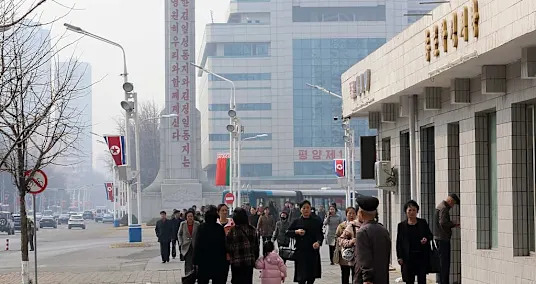
China has announced that its flag carrier, Air China, will resume direct flights to North Korea after a six-year pause, following the restoration of passenger train services between Beijing and Pyongyang.
This marks a significant step toward reopening North Korea, one of the world's most isolated nations, to the world.
Transport links between the two capitals had been suspended since the start of the Covid-19 pandemic in 2020, when Pyongyang implemented a very strict border closure.
While North Korean carrier Air Koryo already resumed flights to Beijing in 2023 and allowed Russian tour groups to visit in 2024, the return of China's air and railways are seen as a major economic milestone, as China has for decades been the main trading partner and a key source of diplomatic and economic backing for the country of 26 million people.
Before the pandemic, there were an estimated 300,000 foreign visitors in 2019, according to South Korea's Institute for International Economic Policy, and Chinese visitors accounted for 90% of all tourists to North Korea. Therefore, the long delay in resuming regular travel had surprised many regional observers.
"The reopening of these borders has been driven primarily by Pyongyang's timeline, which challenges the outdated assumption that Beijing dictates terms to a dependent client state," Seong-Hyon Lee, a visiting scholar at the Harvard University Asia Centre, explains.
Related
Nuclear ambitions complicated the relationship
Despite being Pyongyang’s primary ally, Beijing has frequently voiced disapproval over the North's persistent missile tests and nuclear ambitions. This aspect created a bumpy relationship with Pyongyang, with analysts saying that a nuclear-armed North Korea has often been something of a liability.
The diplomatic normalisation was highlighted last September, when Kim Jong Un attended a massive military parade in Beijing alongside Russian President Vladimir Putin. This was Kim's first appearance at a Chinese military display.
Lim Eul-chul, a North Korea expert at South Korea's Kyungnam University, argues that the war in Iran, in particular, increased "the need for closer coordination between the two nations".
NEUESTE BEITRÄGE
- 1
 Famous SUVs With Low Energy Utilization In 202404.06.2024
 - 2The Difficulties of Getting a Green Card in the US30.06.2023
- 3South Carolina confirms 124 new measles cases as outbreak on the Arizona-Utah line grows13.01.2026
- 4Don’t let food poisoning crash your Thanksgiving dinner14.11.2025
- 5Intriguing Social Unesco World Legacy Locales All over The Planet06.06.2024


Ähnliche Artikel
- Find the Effect of Web-based Entertainment on Psychological wellness: Exploring the Advanced Scene Securely14.07.2023
- 7 Fast Approaches to Let loose Space on Your Telephone in a flash30.06.2023
- Vote in favor of Your #1 4\u00d74 SUVs05.06.2024
- Game theory explains why reasonable parents make vaccine choices that fuel outbreaks25.12.2025
- Stolen Renoir, Cézanne and Matisse were probably uninsured, market sources say02.04.2026
- Fundamental Home Items Each Animal person Needs06.06.2024
- Health insurance premiums rose nearly 3x the rate of worker earnings over the past 25 years08.12.2025
- Which One Energizes You the Most These Tech Developments01.01.1
- Sarkozy says he owes France 'the truth' as he challenges conviction over alleged Libya funding07.04.2026
- Kennedy approves adding two rare disorders to newborn screenings16.12.2025