When you buy through links on our articles, Future and its syndication partners may earn a commission.

This article was originally published at The Conversation. The publication contributed the article to Space.com's Expert Voices: Op-Ed & Insights.
The first step on the moon was one of humanity's most exciting accomplishments. Now scientists are planning return trips – and dreaming of Mars beyond.
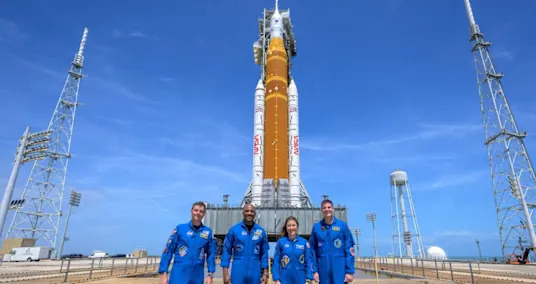
Next year, Nasa's Artemis II mission will send four astronauts to fly around the moon to test the spacecraft before future landings. The following year, two astronauts are expected to explore the surface of the moon for a week as part of Nasa's Artemis III mission.
And finally, the trip to Mars is planned for the 2030s. But there's an invisible threat standing in the way: cosmic rays.
When we look at the night sky, we see stars and nearby planets. If we're lucky enough to live somewhere without light pollution, we might catch meteors sliding across the sky. But cosmic rays – consisting of protons, helium nuclei, heavy ions and electrons – remain hidden. They stream in from exploding stars (galactic cosmic rays) and our very own sun (solar particle events).
They don't discriminate. These particles carry so much energy and move so fast that they can knock electrons off atoms and disrupt molecular structures of any material. That way, they can damage everything in their path, machines and humans alike.
The Earth's magnetic field and atmosphere shield us from most of this danger. But outside Earth's protection, space travellers will be routinely exposed. In deep space, cosmic rays can break DNA strands, disrupt proteins and damage other cellular components, increasing the risk of serious diseases such as cancer.
The research challenge is straightforward: measure how cosmic rays affect living organisms, then design strategies to reduce their damage.
Ideally, scientists would study these effects by sending tissues, organoids (artificially made organ-like structures) or lab animals (such as mice) directly into space. That does happen, but it's expensive and difficult. A more practical approach is to simulate cosmic radiation on Earth using particle accelerators.
Cosmic ray simulators in the US and Germany expose tissues, plants and animals to different components of cosmic rays in sequence. A new international accelerator facility being built in Germany will reach even higher energies, matching levels found in space that have never been tested on living organisms.
But these simulations aren't fully realistic. Many experiments deliver the entire mission dose in a single treatment. This is like using a tsunami to study the effects of rain.
In real space, cosmic rays arrive as a mixture of high-energy particles hitting simultaneously, not one type at a time. My colleagues and I have suggested building a multi-branch accelerator that could fire several tuneable particle beams at once, recreating the mixed radiation of deep space under controlled laboratory conditions. For now, though, this kind of facility exists only as a proposal.
Beyond better testing, we need better protection. Physical shields seem like the obvious first defense. Hydrogen-rich materials such as polyethylene and water-absorbing hydrogels can slow charged particles. Although they are used, or planned to be used, as spacecraft materials, their benefits are limited.
Particularly galactic cosmic rays, the ones that arrive from far exploding stars, are so energetic that they can penetrate through physical shielding. They can even generate secondary radiation that increases exposure. So, effective protection by using solely physical shields remains a major challenge.

Nature's armor
That's why scientists are exploring biological strategies. One approach is to use antioxidants. These molecules can protect DNA from harmful chemicals that are produced when cosmic rays hit living cells.
Supplementing with CDDO-EA, a synthetic antioxidant, reduces cognitive damage caused by simulated cosmic radiation in female mice. In the study, mice exposed to simulated cosmic radiation learned a simple task more slowly compared to unexposed mice. However, mice that received the synthetic antioxidant performed normally despite being exposed to simulated cosmic radiation.
Another approach involves learning from organisms with extraordinary abilities. Hibernating organisms become more resistant to radiation during hibernation. The mechanisms on how hibernation protects from radiation are not fully understood yet. Still, inducing hibernation-like conditions in non-hibernating animals is possible and can make them more radioresistant.
Tardigrades – microscopic creatures also known as water bears – are also extremely radioresistant, especially when dehydrated. Although we can't hibernate or dehydrate astronauts, the strategies these organisms use to protect cellular components might help us preserve other organisms during long space journeys.
Microbes, seeds, simple food sources and even animals that could later become our companions might be kept in a protected state for a while. Under calmer conditions, they could then be brought back to full activity. Therefore, understanding and harnessing these protective mechanisms could prove crucial for future space journeys.
A third strategy focuses on supporting organisms' own stress responses. Stressors on Earth, such as starvation or heat, have driven organisms to evolve cellular defenses that protect DNA and other cellular components. In a recent preprint (a paper that is yet to be peer reviewed), my colleague and I suggest that activating these mechanisms through specific diets or drugs may offer additional protection in space.
Physical shields alone won't be enough. But with biological strategies, more experiments in space and on Earth, and the construction of new dedicated accelerator complexes, humanity is getting closer to making routine space travel a reality. With current speed, we are probably decades away from fully solving cosmic-ray protection. Greater investment in space radiation research could shorten that timeline.
The ultimate goal is to journey beyond Earth's protective bubble without the constant threat of invisible, high-energy particles damaging our bodies and our spacecraft.
NEUESTE BEITRÄGE
- 1
 In these U.S. groups, deaths now exceed births. What’s happening?24.11.2025
- 2Huge solar flare no threat to Artemis 2 astronaut launch to the moon, NASA says30.03.2026
- 3Brexit's Effect on New York's Ascent as a Main Monetary Center30.06.2023
- 4Pick Your #1 Kind Of Bread05.06.2024
- 5Step by step instructions to Choose the Right Auto Crash Legal counselor for Your Case19.10.2023



Ähnliche Artikel
- Dominating the Mastercard Endorsement Cycle: Six Fundamental Stages30.06.2023
- Hanwha Ocean secures orders worth $866m for five vessels26.03.2026
- Reality TV star Spencer Pratt, who lost his home in Palisades Fire, is running for mayor of Los Angeles08.01.2026
- Administrative building in Sharjah region targeted by Iranian drone, UAE authorities announce30.03.2026
- Chinese mega embassy could bring security advantages, says No 1002.12.2025
- Israel's Druze use AI to present to UN testimonies of 'sexual terrorism' against Syrian Druze women10.12.2025
- 10 times the sky amazed us in 202522.12.2025
- 'Dancing with the Stars' semifinals: How to watch Episode 10 tonight, where to stream, who's left and more18.11.2025
- The Advancement and Effect of Dental Embed Innovation on Oral Wellbeing06.11.2023
- Hand Skin Is Additionally Significant - What You Ought to Realize About Hand Cream06.06.2024