When you buy through links on our articles, Future and its syndication partners may earn a commission.

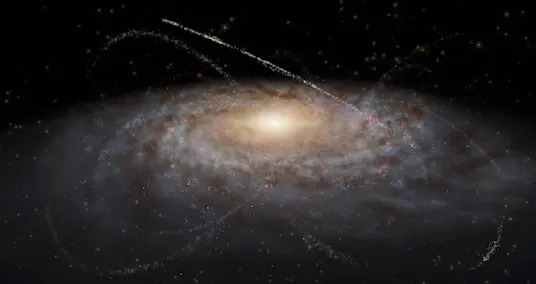
Astronomers have discovered dozens of faint ribbons of stars in the outskirts of the Milky Way using data from the European Space Agency's Gaia mission.
The findings were made using a new algorithm that more than quadruples the number of known candidates of these so-called "stellar streams." This discovery could offer fresh clues about how our galaxy evolved and how its dark matter is distributed, the study's researchers say.
Stellar streams are arcing threads of stars that form when compact star clusters travel through the Milky Way's gravitational field, shedding stars that are stretched out into long, trailing ribbons.
"It's like riding a bike with a bag of sand, only the bag has a hole in it," study co-author Oleg Gnedin, a theoretical astrophysicist at the University of Michigan, said in a statement. "Those grains of sand are like the stars left behind along their trajectory."
Finding stellar streams is valuable because the shapes and motions of these phenomena preserve a record of what gravitational forces have acted on them over time. That makes them powerful tools for mapping the Milky Way's mass, and that mass measurement would include its elusive dark matter halo — dark matter being the invisible "glue" thought to hold galaxies together, but has yet to be observed directly despite decades of effort.
The new study, led by Yingtian "Bill" Chen of the University of Michigan, identifies 87 stellar stream candidates associated with globular clusters, which are dense, ancient groupings of stars that orbit the Milky Way. Previously, fewer than 20 stellar streams had been identified, often only serendipitously in Gaia data, leaving astronomers with too small a sample size to draw broad conclusions.
Most known stellar streams come from dwarf galaxies or clusters that have already been largely torn apart. Streams from still-surviving globular clusters, like those identified in the new study, are much rarer and especially useful because astronomers can compare the stream directly with its parent cluster.
To find them, Chen developed a computer algorithm called StarStream, which searches for streams using a physics-based model rather than relying on visual patterns alone, according to the study. The team then applied the method to Gaia data, which from 2014 to 2025 mapped the positions and motions of billions of stars in the Milky Way.
"It turns out that it's a lot easier to find things when you have a theoretical expectation of what you're looking for when you have a simple phenomenological picture," Gnedin said in the statement.
The results also revealed that many streams do not match the classic expectation of thin, well-aligned trails. Instead, the study reports that some of the newfound streams are shorter, wider or even misaligned with their parent clusters' orbits — suggesting earlier searches may have missed them by focusing only on the most obvious structures.
The expanded sample also provides evidence that some diffuse globular clusters are shedding stars at unusually high rates, a sign they may be nearing complete tidal disruption, the study reports.
Not all 87 candidates are expected to be confirmed, however, as some detections have lower confidence due to background contamination from unrelated stars, the researchers say.
The study's results, along with the algorithm applied to them, can be tested with upcoming observations from next-generation facilities — including the Vera C. Rubin Observatory, NASA's Nancy Grace Roman Space Telescope and the Dark Energy Spectroscopic Instrument — to help verify which streams are real, Chen said in the statement.
"It'll be very easy to adjust the algorithm to future missions," he said. "Once we have the data, it will be very straightforward to apply it."
This research is described in a paper published March 23 in The Astrophysical Journal.
NEUESTE BEITRÄGE
- 1
 Top 15 Online Entertainment Stages for Individual Marking06.07.2023
 - 2Israeli military says it hit dozens of military facilities in Tehran01.04.2026
- 3Ageless Tastefulness: An Outline of Valuable Gemstones and Adornments05.06.2024
- 4Can humans have babies in space? It may be harder than expected27.03.2026
- 5Audits of the Top Science fiction Movies This Year01.01.1




Ähnliche Artikel
- Affordable Care Act enrollment is slightly ahead of last year, despite expiring subsidies08.12.2025
- French rapper Gims placed under investigation for 'aggravated money laundering'28.03.2026
- The Eastern Bongo, Kenya’s Rare Forest Antelope on the Brink07.04.2026
- Mars orbiter sees 'butterfly' crater spread its wings on the Red Planet05.12.2025
- Virtual Domains d: A Survey of \Inundation and Ongoing interaction Mechanics\ Computer game10.08.2023
- Genesis Marks 10th Anniversary With Magma GT Concept Aimed at High-Performance Flagships27.11.2025
- After fleeing past Hezbollah fighting, some Israelis on northern border vow to stay07.04.2026
- Collierville residents with no power as temperatures plunge29.12.2025
- Surprising links between autism, Alzheimer’s could change how we treat both05.04.2026
- Israel faces tough choices over haredi draft exemptions, legal expert warns11.12.2025