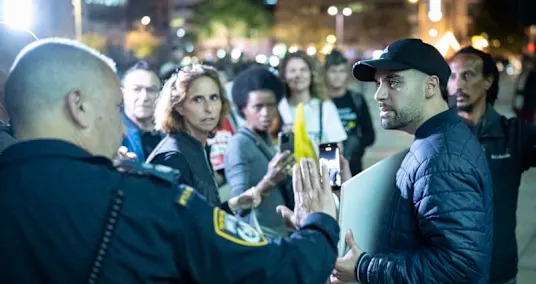
Protests took place in Tel Aviv, Jerusalem, Haifa, and Beersheba, as a survey found broad but uneven support among Jewish Israelis for Operation Roaring Lion.
Israel Police arrested 21 anti-war protesters Saturday night as demonstrations against the conflict with Iran expanded in multiple cities despite restrictions on public gatherings.
Protests took place in Tel Aviv, Jerusalem, Haifa, and Beersheba, with hundreds of participants reported in Tel Aviv and Jerusalem and about 100 in Haifa, marking the largest turnout since weekly demonstrations began. Authorities said 13 people were arrested in Tel Aviv and eight in Haifa.
Police said the gatherings were not approved under Home Front Command regulations that ban events with more than 50 people. Officials said the increase in turnout followed calls by groups opposing the government to protest despite the restrictions.
“During a situation assessment that took place at the scene with a Home Front Command representative… it was clarified that there was a real risk to human life and accordingly, Yarkon [precinct] police commander Tzachi Sharabi ordered the gathering to be dispersed,” police said.
Hadash-Ta’al chairman Ayman Odeh, an Arab lawmaker involved in the protests, criticized the police response, calling officers fascists “in the service of the government” and saying they were afraid of “the heroic citizens who went out, despite everything, to make their voice heard.”

Survey shows broad, uneven support for war
The demonstrations come as a March 2026 survey by the Israel Democracy Institute found broad but uneven support among Jewish Israelis for Operation Roaring Lion. Support was strongest on the Right at 87% and about half on the Left.
The survey also found that Jewish and Arab respondents largely agreed that Iran’s resilience has been stronger than expected. Most Jewish respondents said Israeli society could sustain the campaign for up to one month, while 28% said as long as needed. Arab respondents were less optimistic about how long the public could endure the conflict.
A majority of Jewish respondents said Prime Minister Benjamin Netanyahu’s decision was driven by security considerations, while most Arab respondents viewed it as political.
NEUESTE BEITRÄGE
- 1
 Discovery off Israel’s coast reveals earliest known 2,600-year-old shipment of raw iron28.03.2026
 - 2Why the weirdest sea level changes on Earth are happening off the coast of Japan22.12.2025
- 3The Solution to Flexibility: Developing Internal Fortitude Notwithstanding Misfortune07.07.2023
- 4Bullets in Luigi Mangione’s bag convinced police that he was UnitedHealthcare CEO killing suspect08.12.2025
- 5Putin says Russian forces will seize capital of Zaporizhzhya29.12.2025


Ähnliche Artikel
- FDA approves Wegovy pill for weight loss23.12.2025
- African Forests Have Become a Source of Carbon Emissions01.12.2025
- Antivirus Programming for Exhaustive Security06.06.2024
- Scientists captured female sperm whales on video working together during a birth to protect the calf26.03.2026
- US students studying housing, health outcomes and sustainability win 2026 Rhodes scholarships16.11.2025
- Famous SUVs With Low Energy Utilization In 202404.06.2024
- U.S. overhauls childhood vaccine schedule, recommends fewer shots05.01.2026
- Chris Noth responds to backlash after seemingly shading 'Sex and the City' costar Sarah Jessica Parker: 'It is not news'14.01.2026
- Lebanon says Israeli strike killed 13 people near Palestinian refugee camp18.11.2025
- Artemis moon mission breaks record for distance from Earth06.04.2026