When you buy through links on our articles, Future and its syndication partners may earn a commission.

Before a space telescope ever reaches orbit, and long after satellites are up there, NASA has another way to do frontier science: high-altitude scientific balloons. These balloons can loft instruments to roughly 120,000 feet (about 36.6 kilometers) — high in the stratosphere, above most of Earth's atmosphere—at a fraction of the cost and complexity of a space mission, while still enabling serious astrophysics, heliophysics, Earth science, and technology testing.
Antarctica is one of the best places on Earth to fly these missions. NASA's annual Antarctic Long-Duration Balloon campaign operates from a site on the Ross Ice Shelf near the U.S. National Science Foundation's McMurdo Station.
In the austral summer, near-constant sunlight and stable polar wind patterns can support extended-duration flights, allowing payloads to gather data for days to weeks as they circle the continent.
What is it?
NASA's first scientific balloon flight of the 2025 Antarctica Balloon Campaign lifted off from the agency's Antarctic facility at 5:30 a.m. NZST Tuesday, Dec. 16 (11:30 a.m. Monday, Dec. 15 U.S. Eastern Time) and reached float altitude carrying an experiment called GAPS — the General AntiParticle Spectrometer.
Once airborne, NASA reported the balloon was floating at about 120,000 feet (36 kilometers) above Earth's surface.
Where is it?
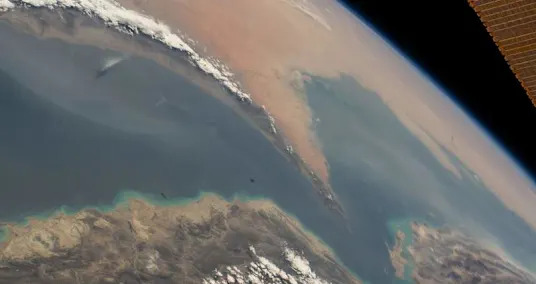
This image was taken near Antarctica Rubilotta where the balloon launched.

Why is it amazing?
GAPS' goal is to look for rare particles from space called antimatter nuclei, specifically antideuterons, antiprotons, and antihelium. Scientists have never clearly seen antideuterons or antihelium in cosmic rays before. If GAPS detects even a single antideuteron, it could give us important clues about the mysterious substance known as dark matter, which makes up most of the universe but is invisible to us. GAPS uses a time-of-flight system to measure how fast the particles are moving and a tracker system to record the interaction.
Now that the balloon has been launched, the GAPS project is underway, hopefully revealing more about the universe around us in due course.
Want to learn more?
You can learn more about antimatter and dark matter.
NEUESTE BEITRÄGE
- 1
 Figure out how to Arrange a Fair Settlement with the Assistance of a Fender bender Legal counselor19.10.2023
 - 2Ukrainian Army Converts E38 BMW 7-Series Into Multiple Rocket Launch Platform18.12.2025
- 3Most loved Amusement Park for Small children: Which One Do You Suggest?01.01.1
- 4Islamabad: Iran allows 20 Pakistani ships through Strait of Hormuz28.03.2026
- 5Two reportedly killed as Israel attacks Hezbollah targets in Lebanon22.11.2025



Ähnliche Artikel
- Collins Foods to offload 20 Taco Bell outlets in Australia31.03.2026
- Two more UN peacekeepers killed in southern Lebanon: UNIFIL30.03.2026
- 6 Exceptionally Appraised Summer Travel Objections06.06.2024
- Does physics say that free will doesn't exist?29.12.2025
- Pilot captures jaw-dropping northern lights show from 36,000 feet (photos)19.11.2025
- Find the Effect of Web-based Entertainment on Psychological wellness: Exploring the Advanced Scene Securely14.07.2023
- Iran, Hezbollah fire rockets at Israel during Passover celebrations02.04.2026
- Fireball sightings are surging across the US — here's what's really going on27.03.2026
- JFK's granddaughter reveals terminal cancer diagnosis, criticizes cousin RFK Jr.22.11.2025
- Carrefour becomes first European retailer to offer shopping on ChatGPT27.03.2026